Forklift wheels drumming over a cracked warehouse slab, and last year's patch is already gone.
Commercial concrete lives or dies under the surface, which is why most commercial concrete contractors want to talk finishes on the first visit. I would rather talk about what is under your slab. We pour and repair floors, docks, aprons and equipment pads for warehouses, restaurants and shops around Providence, from the truck-beaten lots off Allens Avenue to a bakery floor that gets hosed down twice a day.
One thing that never happens on my jobs is concrete going down over soft fill because the schedule was tight. That fill settles, the slab cracks in a line you can follow with your eye, and no amount of commercial concrete floor coatings will hide it.
Below is how the work goes, where we pour, and what moves the number. Ring (401) 394-6425 and we will walk the floor together.
Commercial Concrete Sealing
Commercial concrete sealing is the least glamorous thing we do and the thing that keeps road salt, hydraulic oil and forklift tires from chewing up a floor you already paid for. First the old sealer comes off and the slab gets degreased, because fresh product rolled over a waxy, oil-soaked surface peels off in sheets by the second year.
Then it's a penetrating sealer that soaks into exterior pads and loading docks, or a film former with grit in the final coat where people come in off the wet, two thin passes rather than one heavy one. Plenty of commercial concrete contractors skip the prep and just roll it on dirty. What moves the price is square footage, how much old coating has to be ground off, and whether we're working nights around your shifts.
Sealing is also what makes commercial cement flooring last in a plant where drums get dragged.
Commercial Concrete Construction
Commercial concrete construction is the new pour work: footings, slabs on grade, loading dock aprons, dumpster and generator pads, walks that take delivery traffic all day long. Most of whether that slab holds up is decided before a truck ever rolls in. We dig down to firm ground, roll the gravel in lifts, run vapor barrier under heated space, and tie steel on chairs so it sits inside the pour instead of lying down on the stone.
Joints get cut while the surface is still green, so the slab cracks on the line we gave it and not across your doorway.
Thickness, how much subgrade has to come out, whether a mixer can back right up or we are pumping over a roof, and how much of it runs after you close, those move the price. As a commercial concrete company we trowel hard and flat when a floor is headed for commercial polished concrete later.
Commercial Cement Flooring
Commercial cement flooring is the slab your whole operation runs on, so we pour it for warehouses, commercial kitchens, showrooms and shop floors across Providence. The work starts under the concrete: subgrade proof rolled, stone screeded flat, vapor barrier lapped and taped anywhere moisture sensitive goods or adhesives are going down, and steel sitting on chairs instead of getting hooked up with a boot mid pour.
Saw cuts go in the same day the floor is finished, because that timing decides whether your control joints stay tight or the slab picks its own line. Get it wrong and you get curled joints that beat up forklift wheels for years.
Square footage, slab thickness, demo of an old floor, dock access and whether we pour after your business closes are what shift the number.
Commercial Concrete Floor Coatings
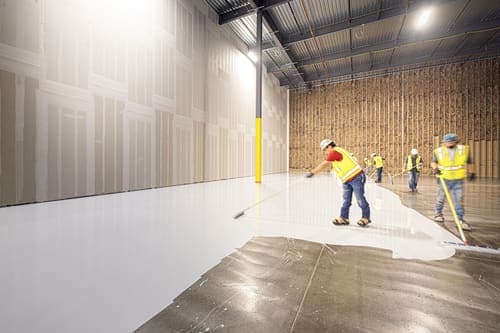
Commercial concrete floor coatings are won or lost before the first bucket gets cracked open. We diamond grind or shot blast the slab so the pores are open, pull oil out of a shop floor that has been soaking it up for years, fill the pinholes, then tape a plastic sheet down overnight to see if moisture is pushing up from underneath.
Coat over a damp slab and you get blisters and sheets peeling off at the forklift lanes inside a year.
A hollow or a dip gets sorted first, which is where commercial concrete leveling comes before any coating, since epoxy follows a low spot and then water and grease settle there.
A built film wears differently from commercial sealed concrete. For a Jewelry District warehouse I'd usually spec epoxy with a urethane topcoat; polyaspartic where you need traffic back quickly. Square footage, how much grinding the old surface needs, and whether we can get ventilation and power in there move the price far more than the coating itself.
Commercial Polished Concrete
Commercial polished concrete starts with grinding, not coating. We run coarse metal bond diamonds first to open the slab and cut off old carpet adhesive or tile mastic, then work up through resin pads until the floor gives light back. Partway through we soak it with a lithium densifier so the surface hardens instead of dusting under traffic.
Rush the grit sequence and the swirl marks show up later, once the display lighting is in, and the only real fix is going back to the start.
What moves the price on commercial concrete: the square footage, how much glue is buried in the slab, how much aggregate you want exposed, and whether we grind after closing in an occupied store. Control joints get a semi rigid filler, since forklift wheels chew unfilled edges. Settled slabs need commercial concrete leveling first, which is us again wearing the commercial foundation contractors hat.
What the job involves
Most commercial concrete jobs are decided before the mix truck ever backs in. We strip the old slab, haul it off, grade and build the subbase, set forms, tie the steel, and work out where rain goes once the surface is hard. Then it's pour, screed, float, and saw the joints while the slab is still green. Dock aprons and drive lanes get more thickness and heavier steel than a walkway does.
What changes the number is square footage, how much demolition comes first, access for a boom or a chute, and whether you need your lot open during trading hours so we pour at night.
Do it badly and you get random cracking from late joints, ponding over soft fill, and a surface that dusts off because someone troweled bleed water back into it. We handle footings and walls too, so we're often the commercial foundation contractors on the same site. Commercial concrete sealing comes later, once it's cured.
What it costs
What a commercial concrete job costs comes down to a handful of things I can size up in ten minutes standing on the site. Access moves the number more than square footage does. If the mixer can back right up to the pour, we move. If we are wheeling it through a loading dock or down a one way downtown, that is hours of labor before a single yard lands. Tearing out and hauling off an old slab counts.
So does what the ground underneath has turned into after years of delivery trucks parking on it. Thickness, reinforcement, the finish you want, and whether we pour after you close for the day all factor in too. Call me at (401) 394-6425 and describe the site. Commercial concrete services quoted sight unseen are guesses, and guesses only ever get corrected upward.
When commercial concrete is the wrong fix
Sometimes commercial concrete is the wrong thing to buy, and I'd rather say that before the saw hits anything. If your slab is stained and rough but still sitting flat and shedding water, resurfacing gets you a clean surface without a dumpster parked in your lot for a week.
If the ground under it is on the move, new concrete flatwork will crack in the same line within a season or two, so that's a footing question and commercial foundation contractors should be under there before anybody pours concrete. If it's just the front entry, we rebuild the concrete steps and leave the walk where it is.
And a floor soaked through with hydraulic oil won't hold commercial polished concrete or a coating no matter who sells it to you. That one ends in concrete removal and a fresh pour.
Why choose us for this
You have a slab, a dock apron or a walkway that your tenants keep bringing up, and what you want from a commercial concrete crew is to hire once, not supervise anybody, and not think about that surface again for years. Fair enough.
The figure I give you is tied to square footage, slab depth, how close a ready-mix truck can get, and what we find when the old pour comes out. If one of those shifts, you hear it from me before the pour, not afterward on the invoice.
A cheaper quote on commercial concrete construction usually gets there by thinning the slab an inch or sawing the control joints a day late, and a late joint means the slab picks its own crack line, straight across your traffic lane.
The estimate costs you nothing and does not put you on the schedule.
Frequently asked questions
Can you repair what we already have, or does the whole slab have to come out?
Often we can repair it. Spalled surface, a few isolated cracks, a sunken panel at a dock door, that's commercial concrete we can save with a saw cut, a clean edge and a bonded patch. When the subbase has washed out and the panels rock under a loaded truck, patching is throwing good money after bad and we'll tell you that on the walkthrough.
When can trucks get back on a fresh pour?
Foot traffic the next day, rubber tire traffic at about a week, and full design strength around 28 days. We pour six inches over compacted stone for truck routes and four for light duty. In cold weather we blanket the slab, which is the step some commercial concrete companies skip to save a day.
Contact The Providence Concrete Company now
Call us now if you want a commercial concrete company in Providence that walks the floor before saying a word about scope. Have a few things handy when you ring: rough square footage, what runs over that slab today, whether forklifts and delivery trucks use it, and how many days you can stand to be shut down.
Those are the things that move the price, along with access, how thick the pour has to be, and what shape the base is in once we saw a test piece out of it.
We are here nine to five on weekdays, and when a loading dock is coming apart and will not hold another season, we will come out on a Saturday.
Plenty of commercial concrete companies will quote off a photo. We would rather measure. (401) 394-6425.