A curb line that's cracked, slumped, or missing a chunk where the plow blade caught it.
Curbs in Providence live a hard life. Plows clip them, road salt works on them, and sooner or later a delivery truck decides your corner is a turning radius. We pour concrete curbs all over the city anyway, and we pour them to stay put: a solid stone base under the whole run, joints cut where we want the crack instead of where the concrete picks its own spot, and a line you can sight down without wincing.
What I won't do is set concrete curb forming over soft ground and watch the run sag by the second winter, because a sagging gutter line sends water at your foundation instead of the catch basin. Length, access and how far the old curbing has already dropped all show up in the concrete curbing cost.
Further down you'll get the forming, the ramps, the mow curb work and the questions we field most. Or ring (401) 394-6425 and we can walk your curb line together.
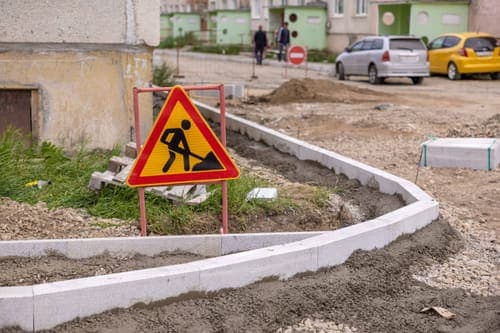
Gutter Curb
Gutter curb is the one that has to actually work, not just look sharp. It's a curb face and a flat gutter pan poured together, usually twelve to twenty-four inches of pan, and its whole job is moving water to the catch basin instead of letting it sit.
We shoot grades before anyone touches a form, because a concrete curb gutter that's off by a quarter inch over ten feet gives you a birdbath, and in Providence a birdbath in February is a sheet of ice by Saturday.
Ponding is the failure you see everywhere. Water sits, freezes, works into the joint, and by the third winter the pan is spalling and the curbs behind it are lifting.
We run string line the whole length and water-test it at Providence Concrete Company before we call it done.
Concrete Curb Installation
Concrete curb installation starts well before the truck shows up. We string a line, check the fall so water runs where you want it instead of sitting against your garage, dig out to solid ground, and set forms to that line. Then we place, screed, tool the face and the radius, and cut joints every ten feet or so, because concrete cracks and the joints decide where.
A concrete curb for a driveway apron is usually a day's work. Long runs, tight access, or hand-carting mud past a fence in Olneyville stretch that out.
Price follows the length of the run, how much old curbing has to come out, curves versus straight shots, and whether we can back a truck to the pour.
Curbs done cheap slump, hold puddles, and start spalling the first salted winter.
ADA Compliant Curb Ramps
ADA compliant curb ramps are the part of this trade where an inch decides everything, because a ramp running steeper than 1:12 fails inspection no matter how clean the trowel work looks. We keep the running slope under 8.33 percent, hold cross slope at 2 percent or less, run the ramp at least 36 inches wide, and set truncated dome panels the full width so a cane finds them before a foot does.
Flared sides get 1:10 where people cut across them.
Get that wrong and there's no patching your way out of it. The concrete curb ramp comes out with a saw and goes back in, which is why Providence Concrete Company shoots grades on the corner before anyone touches a mixer. Figure a day of forming and pouring per corner, plus cure time before the crosswalk opens again. Federal Hill corners almost never start level.
Concrete Curb Forming
Concrete curb forming is where a curb is won or lost, because concrete keeps whatever shape you hand it. We pull a string line off finished grade, then stake forms every three feet or so, tighter on radii where we switch to bender board so the curve reads smooth instead of like a string of small decisions. Wet mix pushes hard.
A form that bows a half inch in the middle leaves a belly you'll notice from the sidewalk forever, and on a gutter curb that belly ponds water and turns to ice by February.
Before any truck backs in, someone at Providence Concrete Company walks the forms with a level and a tape. We use air entrained mix, tool control joints every eight to ten feet, and strip the forms the following day.
Concrete Curb For Driveway
A concrete curb for driveway edges does two things: it holds the asphalt or slab from spreading, and it keeps the lawn from creeping over the top every summer. We pull a string line off the apron, set forms to the grade you actually have rather than the one you wish you had, and pour a stiff mix so the edge holds its shape instead of slumping while we tool it.
Where this curbing goes wrong is what's under it. Poured over loose fill, it looks sharp for one winter, then a plow blade catches the proud corner and the run rocks loose in sections. Kept low at the driveway mouth, the blade rides right over.
The length of the run, whether an old asphalt lip has to be broken out, and how near the truck can back in all shift the number.
Cement Curbing
Cement curbing and concrete curbing are the same animal, so don't let anyone charge you extra for the fancier word. What actually matters is the mix. We pour air entrained concrete for curbs here, usually around six percent air and a 4,000 psi mix, because Providence winters and the salt trucks coming off Broad Street will chew through a lean, airless pour in two or three seasons. You'll see it as flaking along the top edge first.
We tool contraction joints every ten feet or so, strip forms the next day, and keep the curbing damp or under compound while it cures. Give it a week before anything with wheels touches it.
Cheap curbing fails from the inside out, which is why Providence Concrete Company won't cut the water content loose just to make a pour go faster.
Concrete Curb Ramp
A concrete curb ramp is the piece that lets a wheelchair, a stroller or a loaded hand truck get from sidewalk to street without a two inch lip stopping it cold. The work starts with curb cutting: we saw the existing curbs and gutter line clean, break out the old section, and form the ramp with its side flares so the transition works from every direction. Slope is the whole job.
Roughly one inch of fall per foot on the run, cross slope held flat, and the detectable warning panel set into wet concrete before it stiffens. Miss that by a hair and water ponds at the bottom, freezes in January, and you've built a skating rink where the ramp should be.
What moves the cost is how much curb comes out, whether the gutter gets re-poured, and truck access.
Mow Curb
A concrete mow curb is the strip of edging we pour between your lawn and your beds so the mower wheel rides right up on it and the string trimmer stays in the truck. We trench about six inches deep, set a stable base, and run the curb four to six inches wide, either hand formed or shot in with a curb machine like an extruded curb.
Then we tool control joints every few feet, because concrete cracks where you tell it to or where it wants to, and only one of those looks good along a front walk.
Skip the joints and the depth and you get a wavy, broken line by the second winter, with grass creeping through every gap.
Most home runs go in within a day, mulch beds included.
Extruded Curb
Extruded curb is the machine work: a curb machine walks a stiff, low slump mix out onto your lot in one continuous ribbon, no forms, no stakes, several hundred feet in a day when the base is ready. We use it for parking lot islands, landscape edging and the mow curb along a bed where a formed pour would be overkill.
It sticks by bond, which is why we sweep and clean the asphalt first and cut control joints every six to ten feet. Skip either and you get a curb that pops loose in sheets the first February thaw. It also has limits, and I'd rather say so now: a plow blade will shear extruded curbing off a lot faster than it will hurt formed concrete curbs, so anywhere trucks turn hard, Providence Concrete Company forms it instead.
Monolithic Curb
A monolithic curb is one pour, curb and gutter face together, with no cold joint between them for meltwater to sneak into. That seam is exactly where separately poured work fails here. Water finds it in November, freezes, and by March the gutter line has lifted and a plow blade catches the lip and takes a chunk with it.
So we set forms as one run, compact the base properly, and place an air-entrained mix that can take our freeze-thaw cycles, then tool control joints roughly every ten feet so it cracks where we decided instead of where it feels like it.
Most of these go down in a day or two once forms are set, though keep traffic off for a week.
Length, curb height, demolition of the old concrete curbing and how close we can get a truck are what move a Providence Concrete Company quote up or down.
Repairing Concrete Curb
Repairing concrete curb is really a question of how much is still worth saving. If the face is spalling from road salt and a plow blade caught the corner, we saw cut back to sound material at the nearest joint and pour a full section rather than smearing a patch on the front. Skim patches on concrete curbs pop off by the second February. Every time.
We drill and dowel into the existing curbing so the new piece and the old piece move together, use a stiff air entrained mix, and keep the gutter curb pitched so water still runs where it always did instead of ponding at your apron.
Small repairs go in a day. Traffic stays off for a week, longer in cold weather, and at Providence Concrete Company we'd rather tell you that up front than watch tire marks set into fresh work.
Decorative Curbing
Decorative curbing is the part people notice from the street: a continuous border around the beds, a tree ring, a stamped edge running the length of the drive. We extrude it in one ribbon with the color mixed through the whole batch, stamp the pattern while it's still green, and cut joints every few feet so the curbs crack on the line we gave them instead of wherever they feel like.
Plenty of curbing companies dust color on the surface afterward because it's faster. One season of salt and a shovel blade and your slate finish is plain gray again.
Footage is the big lever on cost, then how many curves and corners you want, the pattern, and whether old plastic or brick edging needs pulling first. A side gate the machine won't fit through changes the plan too.
What the job involves
The job involves a lot more digging than pouring, which surprises people every time. We snap a line, saw out whatever has failed, haul the broken pieces off the property, then set crushed stone under the run and tamp it flat before a single form goes down. A short stretch of residential curbs takes most of a morning. A longer concrete curb gutter line along an apron, where the water actually has to go somewhere, runs a full day.
Things that move the number: how long the run is, how much old concrete has to come out, whether the truck can reach with the chute or we're barrowing it past a fence, and whether there's concrete curb cutting involved to tie into what's already there.
Skip the stone underneath and it settles and tips within a couple of years.
What it costs
What it costs depends less on the concrete itself than on everything around it. A straight run of mow curb along a flat side yard is one number. A concrete curb for driveway with a radius at the apron, dowels drilled into the existing slab, and a jackhammer day to haul out the broken piece that's already there is another.
Concrete curbing cost moves with linear footage, how many curves we're forming, whether we're pouring in forms or running extruded curb off the machine, gutter pan width, and whether ADA compliant curb ramps need detectable warning panels set into the pour. Access counts too. If the truck can't back within a hose length, we're wheeling it.
Call Providence Concrete Company at (401) 394-6425 with your footage and we'll price it properly.
Cheap curb tells on itself by the second February, when the plow catches a high edge and takes the face off.
When curbs are the wrong fix
Sometimes curbs are the wrong fix, and saying so before we form anything saves you real money. If the edge is sound but the slab behind it has settled a couple of inches, new edging just frames the problem. That is concrete repair territory, or a tear-out and replacement of the concrete driveway, not a job for any concrete curb company.
Repairing concrete curb where one section has broken is worth doing; ripping out forty feet because six inches spalled is not. And when water is heading toward the house, the grade changes first, or you have poured a dam beside a concrete foundation that already gets damp every wet stretch. If what you really want is a better looking front walk, stamped concrete or one of the decorative concrete finishes beats concrete garden curbing every time.
Why choose us for this
Why choose us for this, and not the truck that quoted less? Because your curb line is spalled, sunk, or shoved off true by a plow blade, and you want it dealt with once and then off your mind for years.
The cheaper bid usually comes from a machine running extruded concrete curb straight onto whatever grade is already sitting there. No forms, no dowels tying it back into the slab. We hand-set and brace poured concrete curbing instead, which eats hours that shortcut skips, and that is the difference between our number and the low one.
Broken sections and the slurry off any curb cutting go out on our truck, not onto your grass. And the estimate costs you nothing and puts you under no obligation to book us, which is more than a lot of concrete curbing contractors will tell you.
Frequently asked questions
Can you fix a cracked curb, or does the whole run have to come out?
Often we can fix just the bad part. Repairing concrete curb sections makes sense when one or two lengths are broken and what's underneath is still firm. Once curbs are crumbling along ten feet or leaning outward, patching is lipstick, and we cut the section out and pour it back to match.
How long until I can drive over a new curb?
Walk on it the next day, drive on it at seven days in warm weather, longer when we pour in the cold. Curing runs on temperature, not your calendar.
Can you cut an opening for a new driveway?
Yes, concrete curb cutting is regular work for us. We cut clean vertical edges instead of breaking them ragged, then form the depressed section so water still runs the gutter line.
Contact The Providence Concrete Company now
Contact the Providence concrete company you'd actually want forming the curbs at the edge of your property, and let's talk about the run itself. Call me at (401) 394-6425 and tell me how long it is, whether a mixer can get within a chute's reach of it, and how much of the old curb has to come out before anything new goes in. That's the scope right there: linear feet, access, demolition, and grade.
Plenty of curbing companies will price a job off a photo. I'd sooner see where the water goes, because a curb set a half inch low sends runoff across a walkway instead of into the gutter, and no amount of good finishing fixes that.
Leave a message during the day and you'll get a call back from me, not a dispatcher.