Your front steps are cracked, the top tread rocks when you stand on it, and the handrail moves with you.
Nobody in Providence admits their concrete steps have gone bad until somebody comes down them with an armful of groceries. We rebuild and pour concrete steps all over the city, on triple deckers off Atwells and capes out toward the Cranston line, and the first thing we do is find out what the old ones were sitting on, because that is usually the actual problem.
A skim of mortar troweled over a crumbling tread is not a repair. It lets go within a season and takes a chunk of the step with it. So we cut back to sound material and build off a real footing.
Riser count, demolition and whether a truck can get near the front are what move the number.
Below: how the build goes, where precast concrete steps make more sense, when steps are the wrong fix entirely, and the questions people ask first. Ring (401) 394-6425 and we will come look at yours.
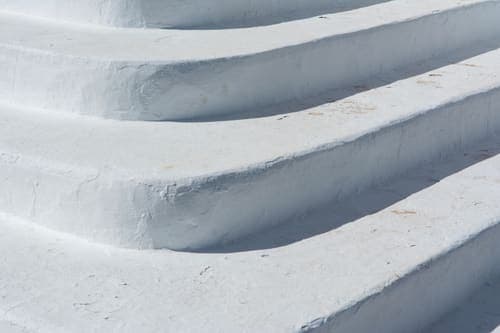
Precast Concrete Steps
Precast concrete steps come to you already cured, cast at a plant and set with a boom truck in one visit, which is why they suit a front door that has been unusable for weeks. We break out the old unit, dig down, bed the spot on crushed stone tamped flat, then set the run so the top tread meets your threshold instead of sitting a finger low.
Skip the stone and the whole piece tips back toward the house within a year, and rain starts sitting against your sill.
What moves the price is the number of risers, the width of the platform, and whether the truck can swing close enough to place it, which on a triple decker with cars parked both sides is the real question. Poured concrete stairs are what Providence Concrete Company suggests instead when the opening is odd or a curve is involved.
Paved Steps
Paved steps are concrete stairs with a face on them: a poured core underneath, then brick, bluestone or paver treads set on top in mortar. We build the core first and let it cure, then bed every tread and riser so water can't sit behind the veneer and push it off.
Dry-set on a bed of sand looks terrific in September and starts spitting pavers loose about the time the plows come out, because the joints hold water and nothing at all is holding the stone.
What moves the price is the count of risers, whether there's a landing partway up, the stone you pick, and how far we're wheeling material down a narrow Elmhurst driveway. Poured concrete steps are quicker and cheaper. Paved ones are what you build when the front of the house is the whole point.
Cinder Block Steps
Plenty of the older triple-deckers around here came with cinder block steps, and half of them are leaning by the time I get the call. Block is only as good as what's under it, so if the original crew set it on a few inches of gravel and hope, the whole run tips toward the sidewalk and the mortar joints open up like a zipper.
We dig footings down past frost depth, around forty two inches, pour them solid, then lay the block, fill the cores with concrete and rod, and cap the whole thing so it reads as one set of concrete stairs instead of a stack of parts. A concrete landing for stairs at the door gets the same footing treatment.
Riser count, hauling distance and demo of the old set are what move that price.
What the job involves
The job involves a lot more digging than most people picture. We break out the old set, haul it off, and dig footings down past the frost line so your new concrete steps bear on solid ground and crushed stone instead of the loose fill somebody backfilled against the foundation decades ago. Then forms, steel, and air entrained concrete, poured in one go so there's no cold joint waiting to open up.
Treads get a slight pitch out front so rain runs off, and a broom finish so nobody's skating on them during a sleet storm. Forms come off the next day, and you stay off while it cures.
Short the footing and one riser settles taller than the rest by year three. That's the one that catches a toe.
Size, riser count, whether there's a landing, how far we can wheel concrete from the truck, and whether we're demolishing old cinder block steps that come apart in chunks all move the number.
What it costs
What a set of concrete steps costs comes down to how many risers you need, how wide the flight is, and the size of the concrete landing for stairs at the top. Three treads up to a small landing at a back door is nowhere near the job a six riser run to a raised porch with return walls is. Demolition moves it too.
If an old crumbling flight has to come out and get hauled away, that's work before the work. So does access: a truck that can get close to the walk is one thing, wheelbarrows down a narrow path between two houses is another. Pouring in the cold months means tenting and blankets, and that shows up in the number.
Give me the height from your door to the ground at (401) 394-6425 and I can price it properly, footings included, because steps set on a real footing don't pull away from the house.
When concrete steps are the wrong fix
Sometimes concrete steps are the wrong fix, and you deserve to hear that before anybody swings a hammer at your stoop. If the treads are solid and the trouble is one crumbling nose or a hairline crack, concrete repair patches it and you keep the flight you already have.
If the stoop has settled because water has been running under it for years, new risers will sink right along with the old ones, so the drainage gets sorted first or nothing holds. Where you only have a riser or two of grade, a wide landing and some concrete paving out to the walk is kinder to your knees. If the real trip hazard is the sidewalk and the curbs at the street, that is its own pour.
And when the shape is fine and you just want it to look sharp, stamped concrete over a sound base skips the concrete removal completely, which is where most of the labor hides.
Why choose us for this
You've got steps pulling away from the house, or a tread with a corner broken off that everybody hops over on the way to the door, and you want concrete steps you can stop thinking about. Fair enough.
The low number on the phone usually gets there by pouring onto dirt with a shovel of gravel under it, no footing carried down deep, no steel in the risers. Those look terrific in June and start tipping away from the siding by the second winter, and then you're buying them twice. I'd sooner walk off a job than pour a set onto ground I haven't dug out and tamped properly.
What moves your number is the depth of the dig, how many risers, and how tight the access is alongside a triple-decker. Looking at it and giving you a figure puts you under no obligation.
Frequently asked questions
How long before I can use my new concrete steps?
About three days. We strip the forms the morning after the pour, and light foot traffic is fine once the surface has hardened. Anything heavy, a dolly or a washing machine, give it a week. The concrete keeps gaining strength for a month, so skip the rock salt that first cold stretch and throw sand down instead.
Can you repair what I've got, or does the whole flight have to come out?
If the treads are chipped but the core under them is solid, we rebuild the faces and leave the rest alone. Once the risers sound hollow, or the flight has tipped back toward the house, patching is money down the drain. I tap the treads and look at the seam against the foundation before I tell you which one you have.
Will you tear up my walkway getting the old steps out?
No. We lay plywood over the walk and the grass line before the hammer comes out, and the footing excavation stays inside the step footprint. The mess is broken concrete and dust for a day, and it leaves in the truck.
Contact The Providence Concrete Company now
Call us at (401) 394-6425 and you get a concrete company in Providence looking at your front stoop, not a message pad. Plenty of concrete contractors will quote off a photo you text over. I want to see the site: the total rise from the walk to the threshold, how many risers that works out to, whether the railing is bolted through the treads and has to come off and be reset, and how close the truck can get.
A tight drive in Mount Pleasant changes how we move material more than the size of the stoop does. Then I tell you straight whether your concrete steps need replacing or just a rebuilt tread nose. Somebody's at the phone weekdays, nine to five, and a message left after that gets a call back. We hold a current license, and we're bonded and insured.