Half the yard is mud, the grill wobbles, and nobody actually sits out there.
A concrete patio is the one part of a yard people stand on, so we pour it like a floor, not like a sidewalk that got wide. We do this work across Providence and the towns pressed up against it, everything from a square pad behind a triple decker to a stamped concrete patio with a fire pit sunk into one corner.
Size moves the price, so does access for the truck, whether there is an old slab to break out, and what finish goes on top. And if you have been scrolling through epoxy patio colors, those really belong on a garage floor or a covered slab. Out in the weather I use color mixed through the mud instead, because a coating on an outside patio peels and then you are looking at flakes all summer.
Keep reading for what the pour involves and when concrete is the wrong answer here. Or ring (401) 394-6425 and we will walk the yard together.
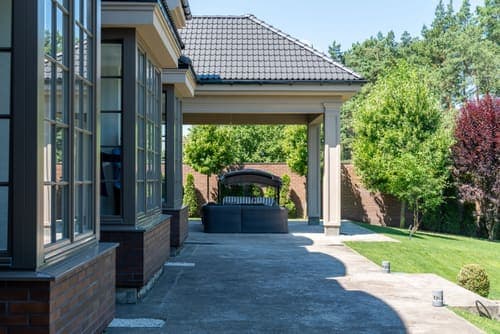
Stamped Concrete Patio
A stamped concrete patio is a regular pour that gets textured with mats while the slab is still green, which is how you end up with the look of a flagstone patio without weeds pushing up between forty separate stones. Pattern and color get settled before the truck rolls, integral color in the mix and a release shade over the top, because once that concrete is down nobody is changing their mind.
We cut the control joints along the grout lines so they vanish into the pattern. Skip that step and the slab cracks wherever it pleases, usually straight across the middle.
Some concrete patio contractors will push epoxy patio colors at an outdoor slab. That's a garage floor product, and it peels out in the weather. As concrete contractors in Providence we reseal instead, every three to five years, so the color stays deep rather than chalky.
Paved Concrete Patios
Paved concrete patios are the plain poured kind: one slab, broom or steel troweled, no pattern pressed into the surface. We strip the sod, dig down to solid ground, lay and compact gravel, then pour four inches of concrete, thicker where a hot tub or an outdoor kitchen is going. Control joints get cut while the slab is still green, so it cracks where we put the line instead of straight through your seating area.
Skimp on the compaction and the patio settles in the first wet stretch and pulls away from the house, which is most of the sunken patios we get called out to tear up. Size, access for the mix, and whether there's an old slab to break out are what move the price. As concrete patio contractors we'd sooner spend the extra hour on the base than the finish.
Screened In Patio
A screened in patio starts with a slab that can carry a roof, and that's a different pour from a plain concrete patio. We thicken the perimeter and set footings under every post location, because posts bearing on four inches of flat slab will settle a corner, and once a corner drops the screen frames rack and the door quits latching. Anchor bolts go in wet, not drilled in afterward.
Pitch matters less under a roof, but I keep a slight fall toward the screen line so wind driven rain off the bay runs out instead of sitting at the sill. Size, footing depth, and how close we can back the truck move the price more than anything else. One bonus: the floor stays dry in there, so a painted concrete patio finish holds up far longer than it does on open outdoor patios.
Outside Patio
An outside patio is the slab your grill, your table and your father in law's opinions all end up on, so we pour it to carry that. Four inches over a base we pack down properly, wire or bar through the middle, and a straight edge form so the perimeter of the concrete patio doesn't crumble the first time somebody goes at it with a snow shovel.
Cheap concrete patio slabs are usually thin at the far corner and settle toward the house, and then every rain puts a puddle at your back door.
Size moves the price, and so does access. A yard you reach through a four foot gap between triple deckers means wheelbarrows instead of a chute, which adds hours.
Keep off it a day, chairs after a week, hot tub much later.
Flagstone Patio
A flagstone patio is really stone plus whatever is under it, and the under it decides how it ages. We wet-set natural cleft bluestone in a mortar bed over a poured slab, with the pitch built into the concrete so water runs off instead of parking in the joints. Laid dry on sand, the pieces start rocking under a chair leg by the second summer and the joints fill with weeds.
Thickness counts. Irregulars around an inch and a half take a table and a grill. The thin stuff splits.
What moves the concrete patio cost here is fitting: sawn rectangles go down quick, jigsaw irregulars are slow handwork, and a narrow gate means stone gets carried in by hand. Some folks land on paver patio designs instead once they see both laid out.
Pergola Patio
A pergola patio has to be planned before the concrete truck rolls in, because the posts want real footings under them, not lag bolts sunk into four inches of slab. We mark the post locations with you, dig piers below the slab line, and set the anchors in the wet pour so the hardware and the pad end up one piece. Plenty of concrete patio installers bolt the posts down after the fact and call it finished.
Then the first nor'easter leans on that roof and lifts a chunk of the edge with it. We thicken the pad where the posts land, and a clean concrete edging patio detail keeps that perimeter from crumbling once the shade holds moisture on it. Post count, pier depth and how far the digging equipment has to travel are what move the price.
Outdoor Patios
Outdoor patios take more abuse than any floor inside your house, so what goes under the slab matters more than what you see on top. We strip the sod and soft soil, lay crushed stone, set the grade so rain runs toward the yard and not at your foundation, then pour four inches of concrete, six where a hot tub or a grill station is headed.
Concrete edging around a patio keeps mulch, beds and stone chips off the surface and gives the pour a clean line to stop at. Plenty of concrete patio installers treat the pour as the whole job; the base is where a concrete patio is won or lost. Size, truck access down the side of the house, how much dirt comes out and whether you want patio pavers installation running off toward a walkway all move what it takes.
Patio Fire Pit
A patio fire pit is the piece we lay out before anything gets poured, because you can't set 600 degrees of burning oak on a four inch slab and expect it to shrug that off. Ours get a firebrick liner and a steel ring with an air gap behind them, and we thicken the slab underneath so the surface doesn't flake apart by the second February.
On a sealed concrete patio we hold the sealer back about a foot from the ring, since acrylic clouds and scorches when it cooks.
Wood or gas changes the build. Gas means a sleeve goes in before the pour, and deciding later means saw cutting your brand new patio.
Half the concrete patio repair calls concrete contractors in Providence take start with a store-bought pit dropped on green concrete in July.
Patio Design
Patio design starts before anybody backs a truck up your driveway. I chalk the outline on the grass and drag a few chairs onto it, because a 12 by 16 slab sounds enormous until you seat six people and everybody pushes back from the table at once. Guess at the size and you spend the next ten summers sidestepping the grill to get to the back door.
After that it's the details, and the details are where these go right or wrong. Control joints land where your layout wants them, not wherever a crew feels like tooling a line. A concrete edging patio border in a darker mix frames the whole slab. A tinted concrete patio reads a lot warmer than plain gray under a Fox Point maple in October.
And a sealed concrete patio keeps that color instead of going chalky on you by the third summer.
Painted Concrete Patio
A painted concrete patio is the quickest way to change how a slab looks and the easiest one to get wrong, because paint sits on top while moisture pushes up from below. So we grind the surface open instead of just pressure washing it, take care of any concrete patio repair first, then roll two coats of acrylic masonry coating with a grit additive so the slab is not an ice rink after a rain.
I will not coat a slab that is still pulling damp through it, because that blisters in sheets by the second summer and then you are paying somebody to strip it. If you want color soaked in rather than laid on, staining concrete patio surfaces is covered further down. Size, how much failed coating has to come off, and the shape the concrete patio is in all move the price.
Staining Concrete Patio
Staining a concrete patio is not painting one. Stain soaks in and colors the slab itself, so there's no film sitting on top waiting to peel in sheets the first hot August week. We pull off any old coating, degrease the spot under the grill where twenty cookouts have left their mark, then acid etch so the color takes evenly instead of blotching. Two passes, then a sealer over the top.
Acid stain mottles and moves like weathered stone, which is the charm of it. Water based concrete patio stain colors give you a flatter, more predictable result. If you've been looking at epoxy patio colors, that's a garage floor product, and out in full sun it chalks and lifts.
Size, how much stripping the slab needs first, and whether you want one color or layered tones all move the number.
Sealed Concrete Patio
A sealed concrete patio sheds spilled beer, leaf tannin and whatever drips off the grill instead of drinking it in. We put down two thin coats rather than one heavy one, because a thick film traps moisture underneath and goes milky white the first damp stretch. New concrete patio slabs get left alone until the slab has cured properly.
Older ones get scrubbed, and if there's a peeling acrylic already on there, stripped, and that stripping moves the price more than the square footage does. Penetrating sealers soak in and leave the surface matte. Film sealers give you the wet look everybody likes and get slick as a Wickenden Street sidewalk, so we mix grit into anything near steps. Patio pavers want their joint sand topped up before sealing, or you glue in a gap.
Plan on redoing it every three to five years.
What the job involves
A new concrete patio starts with digging, not with pouring. We strip sod and soft topsoil, set the grade so runoff heads out into the yard instead of back at your foundation, then lay crushed stone in tamped lifts and set the forms.
Slab goes four inches, more where a hot tub or an outdoor kitchen is in the plan, with control joints cut so the concrete cracks where we put the line rather than across the middle of your table.
If the existing slab is flat, sound and pitched right, we can refinish a concrete patio instead of breaking it out.
Access moves the price more than square footage does. A three-foot gate means the mix comes down the side of the house in barrow loads, which is the same reason patio pavers sometimes make better sense on a tight lot.
What it costs
What a concrete patio costs moves mostly on four things: the square footage, whether the truck can get a chute close to where you want the slab, what's under the ground once we open it up, and what finish you're after. Soft fill, old footings, or a stump nobody ever dealt with all mean digging deeper and hauling more away.
If the mix has to travel by hand through a side gate, that's hours of labor a driveway pour never sees. A plain broom finish sits at one end and stamped, colored work sits at the other. If your slab is still sound and just ugly, a refinish concrete patio runs lighter than a tear out. Framing for a screened in patio means footings under the posts, which changes the layout before we form anything.
Call (401) 394-6425 with your rough dimensions and we'll work out the real figure for your yard.
When concrete patio is the wrong fix
A concrete patio is the wrong call when the ground under it hasn't finished moving. If you're sitting on fresh fill or a bank that wants to travel downhill, what you need first is a concrete retaining wall holding that soil in place, not a slab poured on top of it. Skip that and you'll watch your new patio tilt and open along the joint.
And a delivery area behind a shop isn't residential concrete flatwork at all. That's commercial concrete: thicker, different mix, different crew day.
Got a slab that's flat, solid and just plain ugly?
Don't tear it out. Resurfacing gives you the color and pattern for a lot less work.
Big maple roots eight feet away?
Concrete patio pavers, every time, because you can lift them and reset them. A slab just cracks.
Why choose us for this
Most people who call me about a concrete patio have been staring at the same tired slab out back for three summers and just want it handled once, by one crew, with nobody to supervise and nothing to revisit for years.
So the money goes into the part you never see. Size moves the price, along with access, how close we can get a chute to the back yard, whether an old pad has to come out, and whether you want a tinted concrete patio or plain gray with a border of concrete patio pavers set around it.
I am rarely the low number, and the base is why: we dig and compact it rather than pouring over loose dirt, which is what makes a cheap pour sag and crack at the edges by the second season.
Having me out to measure and talk it through costs you nothing, and you are free to shelve the whole idea after.
Frequently asked questions
Is a poured slab better than patios pavers?
For most back yards, yes. A poured concrete patio goes down as one piece, four inches thick over crushed stone, with control joints cut so it cracks where we tell it to. Pavers give you more pattern choices and any single unit can be lifted and reset, but the sand joints grow weeds and settle unevenly under a grill or a heavy table.
Can you stain what we already have instead of replacing it?
Usually. Staining a patio works when the slab is still sound, sitting flat and draining away from the house. Hairline cracks under a quarter inch we fill first, and color goes over them fine. Once the slab has broken into pieces that rock underfoot, stain just makes a tidier looking problem.
What moves the price?
Size, how easily a truck and wheelbarrows reach the yard, how much old concrete comes out, and the thickness we pour for what you'll put on it.
Contact The Providence Concrete Company now
Contact us now and we'll get a walkthrough on the calendar, ideally before the dry stretch books solid. On site I measure the space, check which way the grade runs so rain leaves your foundation alone, and look at how material gets into the yard.
A side gate too narrow for a buggy adds hours, and that, plus the size, the slab thickness, and whether a cracked old pad has to come out first, moves the price on a concrete patio more than anything else.
If you've been comparing patios, pavers and poured slabs, say so at the walkthrough. Same if staining a patio is in the plan, because it changes how we finish the surface.
We're here nine to five, weekdays. Call (401) 394-6425, and if we're out on a pour, leave a message and you'll hear back.