Your walk has a lip you catch your toe on, and the slab by the back door sits low.
Providence concrete leads a rough life. Salt, tree roots, and a lot of old fill under a lot of this city, which is why so much of the work I get called out for is fixing what somebody else poured in a hurry. We do flatwork, steps and aprons, we set concrete piers under decks and porches, and we do concrete lifting when a slab has dropped rather than cracked apart.
I'm not going to pour over soft ground and call it a driveway.
Keep reading for how the work is done, what moves the price, and the questions people ask a concrete contractor before they hire one. Or call me at (401) 394-6425 and I'll come stand on the thing with you.
Glass Reinforced Concrete
Glass reinforced concrete is what I reach for when you want the look of cast stone without hanging a ton of it off a wall. We cast or spray it in molds at roughly a half inch to three quarters of an inch thick, with alkali-resistant glass fiber mixed through it. That fiber choice matters. Ordinary E-glass gets eaten by the cement's alkalinity and the panel goes brittle within a few winters.
Panels sit in the mold overnight before we pull them, then cure damp under cover. Pull one early and it warps, and a warped column wrap on a Benefit Street porch is obvious from the sidewalk. Mold complexity moves the price far more than square footage, since a one-off shape gets used once. The same hands from our local concrete contractors service set the stainless flex anchors.
Polished Concrete Floors
Polished concrete floors are ground, not coated, and that's the part people don't expect. We run diamond tooling across your slab in five to seven passes, starting with a coarse metal segment that opens the surface and finishing on fine resins, then work in a densifier so the top hardens instead of dusting under foot traffic. A slab that was floated flat polishes beautifully.
One with trowel burns, curled joints or thirty years of tile mastic stuck to it needs repair first, and that repair moves the price further than square footage does, along with how much aggregate you want showing and how many columns and doorways we have to hand-edge.
Push the coarse grit too hard early and you leave swirl marks that no amount of fine honing will hide. It's one of the few concrete services where the finish depends on what somebody else poured years ago.
Concrete Forming
Concrete forming is the part nobody sees once the mix goes in, and the part you end up looking at every day afterward. Plenty of concrete companies treat it as setup and rush it. We build the mold like it matters: two-by lumber, steel radius forms where the edge curves, stakes driven deep, braces tight enough that wet concrete cannot push a belly into your edge.
On a rebuild we start with concrete cutting, sawing the old slab back to a straight line so the new forms have something square to sit against.
Forms usually go up the day before the pour and come off the day after. Pull them green and you tear the corners, and torn corners telegraph through any concrete coatings you lay over the top later. Access and curves are what stretch forming time.
Concrete Pumping
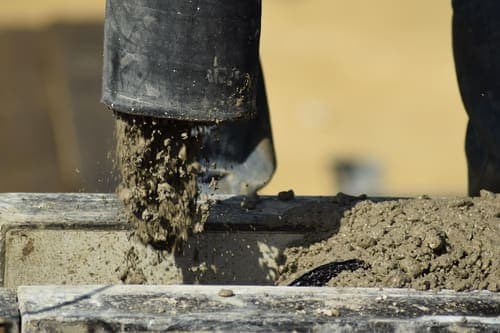
Concrete pumping is how we get mix to a pour the truck can't reach, and around Providence that's most of them: a patio behind a triple-decker off Broadway, a basement slab, footings on the far side of a fence you can't take down. Instead of running forty wheelbarrows across your yard, we thread hose through the gate and place it where it belongs.
Access decides which of the two concrete solutions we bring. A line pump pushes through two or three inch hose for slabs and footings. A boom reaches over the roof when the street is the only place to set up.
What ruins a pump day is a plug. Stiff mix, or hose kinked hard at a corner, and the line locks while the load ages in the drum. So we settle the slump with the plant first, and keep two concreters on the hose end moving.
Concrete Flooring
Concrete flooring is the slab you live on indoors: garage floors, basement floors, the wide open floor of an old mill building in Olneyville somebody is turning into a shop. We pour four inches over crushed stone with a vapor retarder beneath it, because a basement slab sitting straight on dirt pushes moisture up for years and eventually lifts whatever glue-down flooring you put over it. The other half of the calls we get is leveling concrete floor work.
A floor that's off half an inch across a room makes a cabinet run rock and a pallet jack fight you, so we grind the humps down and bring the low spots up with self-leveling underlayment instead of smearing a thin skim over them, which curls and lets go. Not every crew of concreters owns a grinder.
We do, and since we're the same concrete footing contractors forming piers under additions, a thickened edge for a bearing wall goes in with the same pour. Square footage, how we get material into the room, and the shape the old floor is in all pull the number around.
Concrete Footings
Concrete footings are the part nobody ever sees and the part that decides whether everything above them stands straight. We dig down to undisturbed ground, not to whatever the excavator pushed back into the trench, get below frost depth, form the sides, and tie the steel up on chairs so it sits inside the pour instead of lying in the mud at the bottom.
Around here the bucket hits ledge often enough that depth, access for the machine and what the ground turns out to be swing the cost more than square footage ever does.
Poured shallow or over loose fill, a footing settles at one corner and you read about it upstairs: stair-step cracking in the block, a door that starts scuffing. Most American concrete trouble begins down there. As concrete footing contractors we would rather stop the dig and walk you down to look than pour over a soft spot.
Concrete Jacking
Concrete jacking is how we save a slab that has sunk rather than breaking it out: we drill a grid of small holes, pump grout or polyurethane foam underneath until the void is full, bring the panel back up to level, then patch the holes. A sunken concrete walkway, or a garage apron that has dropped an inch and a half at the joint, is a good candidate.
A slab already broken into five pieces is not, and you will hear that from me before we set up.
The price follows how many panels need lifting, how deep the void goes, how far we have to run hose from the truck, and whether water is still washing soil out from under there. Lift too fast and you crack the panel. We go in stages, checking with a level between shots. Most jobs are back the same day.
Concrete Sealing
Concrete sealing is the cheapest thing you'll ever do for a slab, and the one most people put off until the surface starts flaking around the apron. We wash it, etch it, and let the concrete dry out properly first, because sealer rolled over a damp slab turns cloudy white and peels off in sheets, usually right where the afternoon sun hits it. Two thin coats beat one heavy one every time.
Lay it on thick and you get blisters and a surface slick enough to put somebody down. We carry it over the concrete edging and into the joints, where road salt off your tires does the quiet damage. No forms and no concrete boom pump for this one, just hoses and rollers, and you're back on it the same day. Most driveways want it again every three to five years.
Concrete Acid Stain
A concrete acid stain isn't paint, and that's the whole point. The salts react with the lime in the slab, so the color comes out of the concrete itself, mottled and never quite predictable. Slabs we pour ourselves take it best, because we handle the concrete forming and know nobody hit it with a curing compound. Older surfaces are the gamble: tire marks, drywall mud, a patch somebody troweled in years ago, all of it comes through.
It takes fine on reinforced concrete and on stamped concrete paving, just not on anything already sealed.
The step crews skip is neutralizing. Leave acid residue behind and your sealer clouds up and starts peeling inside a year. We scrub, rinse and test before any sealer goes on.
Square footage, grinding time and how many colors you want move the cost most.
Concrete Lifting
Concrete lifting is how I put a sunken slab back where it belongs without tearing it out. We drill ports about the size of a dime, pump structural foam underneath, and bring the slab up to grade while we hold a string line across it. The foam fills the hollow under there too, which is the part that stops it dropping a second time.
Walkways, garage aprons and the tripping lip where a maple root got under the front walk are back in use the same day.
Concrete leveling suits patios, steps, pool decks and interior floors. It won't correct a concrete foundation that's moving for its own reasons, and it won't rescue a slab already broken into loose chunks. Slab size, how far it has to rise, how much foam the void drinks and how close we can park the rig set the cost. If that patio carries a concrete acid stain, lifting saves the finish.
Concrete Overlay
A concrete overlay is a fresh wearing surface, usually a quarter inch to a half inch of topping spread over a slab that looks rough but is still holding together. Think a scaled patio or a garage floor that's pitted from years of salt off the tires. We open the old surface with a diamond scarifier, vacuum the dust out, prime it, then screed and trowel the topping flat.
Bond is the whole game. Lay a topping over dust, old sealer or a panel that rocks underfoot and it'll release in sheets inside a season.
If the slab has dropped, concrete leveling happens first, and the concrete leveling cost rides on how many lifts it takes. An overlay is cosmetic. It won't cure a cracked concrete foundation, and I won't sell it as though it will.
Concrete Pouring
Concrete pouring looks like the simple part: truck backs in, mud goes in the forms, everybody's home by lunch. The hour after that is the one that decides how your slab ages. Bleed water has to rise and leave before a trowel touches it, and a finisher who closes the surface too early traps that water underneath. What you get is a slab that dusts, flakes and starts pitting by its first cold winter.
So we screed, bull float, and then we wait, however much daylight is burning.
Joints get cut the same day, before the concrete decides where it wants to crack on its own.
What moves the price on a pour is square footage, slab thickness, the mix specified, and truck access. If a chute won't reach the back yard, we bring in concrete pumping.
What the job involves
Most of what this job involves happens before any concrete comes off the truck. We break out and haul away the old slab if there's one in the way, dig down, lay a bed of crushed stone and level it, then build forms and set steel. Four inches over a firm bed sits still. The same four inches poured on soft dirt cracks in a line you'll see from the kitchen window every morning.
Then the pour. Screed, bull float, and wait. A concrete finisher earns his keep in that waiting, because troweling while bleed water is still sitting on the surface locks moisture in and the top flakes off in sheets by the following year. Joints get cut, then the slab cures.
Size, thickness, how much tear-out there is, and whether we can get a truck near the forms or we're wheelbarrowing it down a skinny side yard, that's what moves the price on a concrete patio.
What it costs
Cost on concrete work moves with four things: how big the pour is, how thick it needs to be, how close a truck can get, and what has to come out before we start. A back yard concrete patio behind a triple-decker, where the mix travels forty feet by hand, runs higher than a driveway the mixer can back straight up to. Old slab on top of it?
Breaking that up and hauling it off is its own line on the sheet.
Where a cheap number gets cheap is the base and the steel. Thin the slab, skip the gravel, leave the mesh in the truck, and you get cracking that no repair really solves. Good concrete construction spends money underneath, where nobody will ever see it.
Give us a call at (401) 394-6425 with rough dimensions. Depth and access are what move the figure most.
When concrete is the wrong fix
Sometimes concrete is the wrong fix, and saying so costs me work.
A slab that has settled in one piece doesn't need tearing out, it needs lifting back to grade. If what sits under it is soft fill or an old utility trench nobody tamped, fresh concrete construction will crack along that same line inside two seasons, so the dirt gets sorted first or we don't pour. Steps with rebar showing through are past patching, and that's concrete removal followed by new concrete steps.
A driveway breaking up across the whole surface is concrete paving, not a repair. Clipped curbs are a saw cut and a short pour, not a reason to redo the apron. And decorative color over a floor that's still damp from below is wasted money: stamped concrete and concrete flooring both telegraph moisture, usually within a year.
Why choose us for this
You have a slab, a walk or a set of steps that has gone wrong, and what you really want is to hire one crew, once, and then not think about concrete again for twenty years.
So, the things that actually move our number. Access, mostly: a backyard pour we reach by hand takes far longer than one a truck can chute straight into. Then depth, and the state of what is sitting underneath. Soft fill comes out rather than getting poured over, and concrete footings get dug down past the frost line whether or not anybody will ever see them.
We do not pour on ground we have not proved, and that gap is often the whole difference between our price and a cheaper one.
If permeable concrete would serve your drainage better, we say so.
The estimate is free, and nobody has to book anything.
Frequently asked questions
What changes the price of a concrete job?
Size first, then how much old slab has to come out and where the truck can reach. A four inch walk pours faster than a six inch apron a delivery truck will turn on. Poor access means barrowing, and barrowing means hours. If a slab is sound but has just sunk, concrete jacking is the cheaper road.
Will you wreck the lawn getting the mix in?
We keep the rig on the driveway where we can and run plywood over grass so the wheels don't sink. On a pour tight to the house, the beds and the siding get covered before the first load goes past.
Can you pour something that drains instead of shedding water to the street?
Yes. We pour permeable concrete, an open mix set over a stone bed, and it does well on parking pads and side yards that puddle. Silt will clog it, so it wants a vacuum once or twice a year.
Contact The Providence Concrete Company now
Contact me now if you have concrete work lined up for this year, because the good pour weather books out from both ends and August fills before people think it will. Call (401) 394-6425 and tell me what you are looking at: a slab, a set of concrete piers holding up a sagging back deck in Olneyville, an apron crumbling into gravel.
What helps most on that first call is rough dimensions, whether a mixer can get within a hose length of the work, and what is sitting under there now. You reach the owner of the concrete company, not a scheduling desk, and somebody is here weekdays, nine to five, with messages returned.
If it is only concrete sealing on a slab that is still sound, say that, and I will tell you if it needs anything more before we touch it.