Hairline cracks last year. Now there's a chunk missing by the curb and a puddle that never drains.
Nobody wakes up wanting a concrete driveway. You want a flat place to leave the car that doesn't eat a tire. As concrete driveway contractors we pour and repair drives across Providence and the towns around it, and plenty of jobs start out as a cracked driveway repair and turn into a full replacement once we see what the salt trucks and the soft base under that slab have been doing.
I won't trowel mortar across a crack with a loose edge beneath it, because that lets go inside a season and takes good concrete with it. If your apron has dropped, a concrete ramp for driveway transitions fixes the part you scrape every day.
Below is how the work goes, what it costs, when a driveway fix is the wrong answer, and the questions we hear most. Call us at (401) 394-6425 and we'll come look at yours.
Reseal Asphalt Driveway
When we reseal an asphalt driveway, the sealer itself is the last hour of the work and everything before it is the actual job. We blow the surface clean, cut the grass creeping in off the edges, prime the oil spots where your car parks, and fill the cracks first. Sealer bridges a hairline and nothing wider, so anything you can drop a pencil into is cracked driveway repair, not a coating question.
Then two thin coats instead of one heavy one. Thick sealer peels off in sheets by the second winter.
We want 50 degrees and climbing with no rain coming, which in Providence means roughly May through September, and cars stay off it 24 to 48 hours. Every three or four years is plenty. If the mat has gone gray and gravelly, Providence Concrete Company will tell you sealer is lipstick on it.
Asphalt Driveway
Plenty of people call us about a concrete driveway and end up with an asphalt driveway instead, usually because the slope or the shape of the lot makes hot mix the smarter call. We lay it in two lifts, a binder course and then the wearing course, and we roll it while it's still steaming, because asphalt that cools off before the roller gets there never knits together and you'll be looking at that seam come summer.
Edges are where a lot of asphalt driveway companies get lazy. With nothing to lean against, the sides crumble under tires inside a couple of seasons. Most homes here are a day or two of work. If you're weighing a patch against full driveway replacement, the cost to repave a driveway rides on square footage, truck access and how soft the ground under the old mat has gotten.
Driveway Sealing
Driveway sealing is the cheapest job we do on a concrete driveway, and it's the one most people put off until the surface is already flaking. On a fresh pour we wait a full 28 days before anything touches it, because sealing green concrete traps moisture and you get a cloudy, peeling mess by spring.
On an older slab, we scrub it, give it two dry days, take care of any cracked driveway repair first, then put down a penetrating silane siloxane sealer that soaks into the pores instead of sitting on top like nail polish. The glossy film-forming acrylics some driveway contractors love turn slick as the ice at the Dunk the second it rains.
Figure three to five years before a recoat, less where a plow blade scrapes it every December. Size, surface condition and access move what it runs.
Driveway Fix
A driveway fix doesn't always mean tearing the whole slab out. Most concrete driveways fail in pieces: one panel sinks by the apron, another heaves where a maple root found its way underneath. So we saw cut on the existing joints, lift out just the bad panel, dig down and pull whatever soft, wet material caused the settlement, put clean crushed stone back in and pour. One bad section doesn't condemn a concrete driveway.
What I won't do is pour new concrete straight onto the same soggy dirt that sank the first time. You'd be calling about the same square in two years.
A new pour sits lighter than twenty year old concrete until it weathers in. If you've been pricing heated driveway cost, mention it now, because the tubing goes down before the pour, never after.
Asphalt Driveway Repair
Asphalt driveway repair is one of those jobs where the patch you can see is rarely the problem. If your blacktop has alligator cracking, webbed like a dropped windshield, the base underneath has given up and no amount of surface work will save it. We saw out the failed section, dig to the gravel, recompact, then lay hot mix in lifts and roll it while it's still hot.
Cold patch from a bag in February lasts until the first plow scrapes down your street.
Cracked driveway repair with sealant is fair game on anything under about half an inch. Wider than that and water is already sitting in the base, and a Providence freeze and thaw cycle will pry it open like a quahog.
Most single-section repairs are a one day job for us at Providence Concrete Company.
Asphalt Millings Driveway
An asphalt millings driveway is ground-up road surface given a second life, and done properly it's a solid answer for a long dirt drive off Chalkstone or a farm-style approach out toward Scituate. We shape the base first, crown it so the drainage in driveway sheds to the edges instead of ponding at your garage door, then roll it in two lifts with a vibratory roller.
Skip that compaction and you've got ruts by March and a plow blade peeling it up in the first real storm. Millings knit and darken in July heat, so summer is when we like to lay them. They won't hold a crisp edge the way a concrete driveway does, and I'd rather tell you that now. When you want permanent, Providence Concrete Company pours the slab instead.
Sealing Cement Driveway
Sealing a cement driveway is the cheapest insurance you'll ever buy for a slab, and it's the one job people skip until the surface starts to scale. On a new concrete driveway I wait about a month for the slab to cure before anything goes down. Then it's a real clean: degrease the oil spots, etch if the surface has closed up, let it dry all the way through.
A penetrating silane or siloxane soaks in and fights the road salt that comes off your tires all winter. Two thin coats, never one heavy one, or you get milky white blush and a slick spot you'll skate across in the rain.
Most driveways take a day. Size, oil staining, whether we're grinding anything back, and the weather that week are what move the number.
Concrete Driveway Sealcoating
Concrete driveway sealcoating isn't the black emulsion asphalt driveway contractors squeegee across blacktop. On a slab we're putting down a clear silane siloxane sealer that soaks into the pores, so road salt and a plow blade can't chew the top surface into sand.
Two things decide whether it holds: the concrete has to be clean, and it has to be dry all the way through. Roll sealer onto a damp slab on a muggy day and you get a milky white haze locked into the surface that only comes off with a grinder. A new pour waits a good month before anything touches it.
Most driveways around here want it again every three to five years. Size, how much oil and tire rubber we lift off first, and whether the surface is already flaking are what move the price.
Drainage In Driveway
Drainage in driveway work is half the reason a concrete driveway lasts twenty years or cracks up in five. Water has to leave. If the pitch runs back toward your garage door, you get a puddle at the threshold and a sheet of ice on it the first cold night.
So before we form anything, I figure out where the water goes: pitch out to the street, or a channel drain with a cast grate set across the apron when the grade won't cooperate, tied into a solid pipe that actually ends somewhere, a catch basin or a dry well, not just daylighting into the lawn.
Length of that pipe run, how deep we have to dig, and whether we hit ledge are what add time and cost here.
Water trapped under a slab is where most cement driveway repair begins.
Refinish Concrete Driveway
A refinish concrete driveway job is for a slab that's ugly but still solid: spalled top layer, old patch scars, that blotchy gray you notice every time you pull in. We wash it down, open the surface so the new material grabs, then trowel a polymer-modified overlay over the top and finish it broom-textured or stamped. Driveway colored concrete gets pigment mixed through the overlay rather than painted on the face, so a nick doesn't flash white at you.
Cement driveway repair comes first, always. An overlay laid across a crack that's still working will telegraph right through it by spring, and bad drainage in driveway low spots keeps a slab damp from below, which is how overlays let go in sheets.
What moves the price: square footage, how much patching the concrete driveway needs, plain broom versus a stamped pattern, and how close the mixer can park.
Cracked Driveway Repair
Cracked driveway repair is the call I get most, usually after a winter of plow blades and rock salt. Not every crack gets the same fix. A hairline we saw out into a clean V, blow the dust free, and fill with a flexible polyurethane that moves with the slab instead of cracking straight back through.
But when one side of the crack sits lower than the other, the ground underneath has given way, and filling it just hides that until the next thaw. Then we cut out the whole panel, fix what's below it, and pour fresh concrete.
Two panels is usually a day, plus cure time before you park on it. Size, truck access, and how far the cracking has traveled are what change the figure, not the number of cracks you counted.
Crushed Cement Driveway
A crushed cement driveway is recycled concrete, crushed and screened and then rolled tight, and it's a sensible surface for a long run where a poured concrete driveway would cost you more than you want to spend. We grade it, put fabric down over anything soft, lay four to six inches of processed material and roll it while it's damp so the fines bind. Rolled dry, it never locks up, and you'll have ruts in the wheel tracks by spring.
It also needs a crown, or water sits and takes the surface with it.
Plan on topping it up. Plow blades throw some of it onto the lawn every winter, and fresh material every few years brings it back level.
We're concrete driveway contractors first, so if your grade is too steep to hold loose stone, we'll tell you before we start.
What the job involves
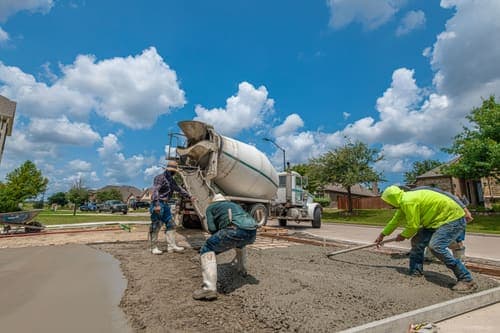
A new concrete driveway starts with the old one leaving: we break it up, haul it off, and dig down far enough to put a real bed of crushed stone under the pour. Then forms, reinforcement, four inches through the body and six across the apron where your car and the oil truck cross.
We tool the joints while the mix is still fresh so the slab cracks where we told it to, not in a lightning bolt down the middle. Broom finish for grip, and if you want driveway stain colors, we settle that before the first load shows up.
Size, access, and whatever's hiding under the old slab move the cost to replace a driveway in concrete far more than the finish does. A skinny run between two houses means wheelbarrows, and wheelbarrows mean hours.
What it costs
Your concrete driveway cost starts with square footage and then moves on everything around it: whether there's an old slab to break out and cart away, how much regrading the ground needs, and whether a mixer truck can reach the pour or we're running wheelbarrows up from the street.
Wire and thickness matter, so does extra depth at the apron where tires turn in off the road, and a plain broom finish prices differently than a colored driveway with a stamped border. Pavers are a separate conversation, and the cost to put pavers in driveway work usually runs above poured concrete, because it's days of hand-setting rather than a morning with a chute.
Call us at (401) 394-6425 with your rough dimensions and what sits there now, and you get a real number.
Thin quotes skip the apron depth. That corner cracks first.
When concrete driveway is the wrong fix
There are a few jobs where a new concrete driveway is the wrong fix, and I will say so before anybody fires up a breaker. Scaling, a worn broom finish, hairline cracks that stop in the top quarter inch: that's a surface problem, and grinding it down and putting a new wearing layer on costs a good deal less than tear-out and a fresh pour.
Chasing decorative concrete finishes over concrete that's already coming apart underneath just gives the failure a nicer texture.
If the garage wall itself is dropping and the slab is following it down, you have a concrete foundation to deal with first. Pour a driveway against that and you'll watch the same crack reopen.
And when the grade at your door has you asking about a concrete driveway ramp while the bank along the edge is sliding toward the street, the concrete retaining wall goes in first. A ramp poured against moving dirt splits along that joint.
Why choose us for this
You've got a concrete driveway that's cracking at the edges, dipping where the tires sit, and you'd like to deal with it once and then forget it exists for a good long while. That's the actual goal. Not craftsmanship talk.
Here's what moves the number when we come and look at it: the square footage, whether there's an old slab to break out and haul off, how a mixer truck reaches the pour, the depth we're going, and how much of the ground under it has gone soft. A cheaper quote usually gets cheaper by pouring thin over whatever's already there, and that shows up by the second season.
If the cost to resurface a driveway makes more sense than replacing yours, or sealing a cement driveway buys you real years, we'll say so.
Coming out to price it puts you on the hook for nothing.
Frequently asked questions
How thick should a concrete driveway be?
Four inches over six to eight inches of crushed stone, rolled tight in lifts, holds cars and pickups fine. Where a work van or a loaded trailer parks, we pour six. Most failures start in the stone under the slab, not the mix, and we cut control joints so the concrete cracks where we put the line instead of where it feels like it.
Can you pour a white concrete driveway?
Close to it. A white concrete driveway uses white cement with a light sand, and it reads as pale gray rather than bright white. It looks sharp, but plow scrape, tire rubber and de-icer show on it more than on standard gray, so plan on sealing it.
Can you replace just the bad section instead of the whole driveway?
Yes, if the base is still sound and only a panel or two have broken up, we saw those out and pour them back. When the slab rocks underfoot and cracks run corner to corner, the stone below has washed out, and a patch buys you a year at most. That is when a full concrete driveway installation makes sense. Size, truck access and how deep we dig move the cost far more than the concrete does.
Contact The Providence Concrete Company now
If you're ready, contact the Providence concrete company that pours this stuff all week: ring (401) 394-6425 and tell me what's sitting out front now. What I want to know first is how big the pad is, whether a mixer can get within chute reach or we're wheeling it, and what's under the old slab. Access is the part people forget.
A tight drive off Smith Street can add half a day of barrowing before a trowel ever touches the surface.
Want a black stained concrete driveway instead of plain gray? Say so early, because stain and sealer go on well after the pour and that shifts the calendar, not the concrete.
Somebody's here Monday through Friday, nine to five. Leave a message after that and you get me back, plus the driveway installers who'll actually show up.