Cracked walk, a slab tipping toward the house, water still sitting in the driveway two days after the rain.
There are more broken walkways in this city than there are Dunkins, and that is saying something. Concrete paving is most of what we do: driveways, walks, aprons, patios and the occasional loading pad. We're one of the few paving companies around here that pours slabs and does paver installation with the same crew, so if you want paver brick edging or a front walk in concrete pavers, nobody has to be phoned in from somewhere else.
Look at paver stain colors outside in daylight, because they all read darker wet.
Fresh concrete poured over a slab that's already crumbling underneath puts the same cracks back inside a year, so we take the old one out first.
What the work involves, what moves the price, and when this isn't the right fix are all further down. Give me a ring on (401) 394-6425 and I'll come look at it.
Roads Paving
Roads paving is the heavy end of this work: private lanes, condo access roads, mill yards, and the stretch of street a developer has to build before the city will adopt it. Concrete goes down thicker there than on any drive, over stone rolled in lifts, with dowels through the joints so panels can't step out of line under loaded trucks. Get the crown wrong and water stands in the wheel paths, and that's where the cracking begins.
What shifts the number on a road is length, how deep the section has to be, whether we can hold one lane open for residents while we pour, and how much of the old surface has to come out first.
Road work is the kind of concrete paving we take on at Providence Concrete Company that plenty of paving companies would rather hand off to somebody else.
Paving Sealing
Paving sealing is cheap insurance on concrete paving you already paid for, and most of the work is prep rather than product. I blow the surface clean, wash it, then wait until it is dry all the way through. Seal a damp slab and you trap a milky white blush under the film that no amount of scrubbing lifts. On pavers, joint sand goes back first, or you are gluing weeds in place for a year.
Sun faded units can take a paver tint to bring the color back, and segmental work like Cambridge pavers soaks up sealer at a different rate than a broom finished slab, so the coat goes on thin and even instead of thick and slippery. Square footage, how dirty it has gotten, and whether you want tint are what move the price. Good sealing gets redone every three to five years.
What the job involves
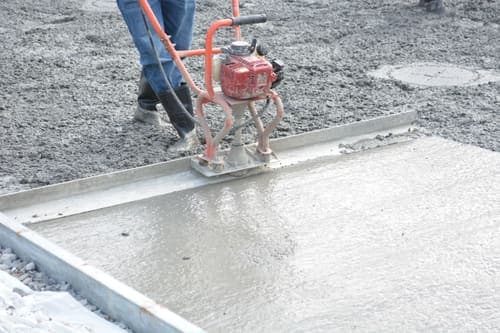
Concrete paving starts with digging, not pouring. We take out the old surface and the soft ground under it, bring in crushed stone, roll it flat, then set forms to a grade that sends water toward the street instead of into your garage door. Mesh or bar goes in, then the pour, then a broom finish so the surface has grip when it rains.
Joints get cut the same day, so the slab cracks along the lines we chose rather than wherever it feels like.
Most of what we get called for as driveway paving contractors is a slab that's lifted at the apron or gone to gravel at the edges. Size, access for the truck, how much depth we're taking out, and how wet the ground is that week all change the schedule. Want concrete paving stones instead? That's a sand bed and edge restraints, a different build entirely.
What it costs
What concrete paving costs on your property comes down to a handful of things: square footage, how deep we pour, what is sitting under it now, whether the mixer can get close, and the finish you want. Tearing out an old cracked slab and hauling it off adds a day. A tight drive down in Fox Point where the chute will not reach means wheelbarrows or a pump line, and that is hours of labor.
Depth moves it too, four inches over crushed stone for a car, six where a work van parks.
Plenty of driveway paving contractors will throw a number at you off a photo. We measure first, because the ground under a slab decides half the price. Call us at (401) 394-6425 and we will come look. If you have also been pricing paver installation cost, that is a separate sheet, since pavers get set by hand, one at a time.
When concrete paving is the wrong fix
Concrete paving is the wrong fix when you have two or three tight cracks and sound ground under the slab. Rip that out and you have bought a whole new pour to solve an hour of concrete repair. A sunken apron or one broken run of curbs is the same story: we cut the bad panel, match it, and leave your good work alone.
Plenty of driveway paving companies will pour anyway, because a slab is worth more on the invoice.
Long private roads, and lots that have to carry trucks by the end of the week, are asphalt. An asphalt paving co can open hot mix fast, and a concrete driveway cannot match that timeline no matter who pours it.
And if what you want is the look, stamped concrete and other decorative concrete finishes can go over a slab that is still solid.
Why choose us for this
Why choose us for this? Because you've got a driveway breaking up at the apron, or a slab that's lifted enough to catch a toe, and you want it handled once and then forgotten about for years. Craftsmanship speeches don't do that. A proper base does.
The number I give you is the number on the invoice, unless you ask me to change the scope halfway through.
Some driveway paving companies come in lower by pouring straight onto whatever dirt is sitting there and skipping the crushed stone under it. Saves them most of a day. It costs you a drive that maps with cracks the first time water gets under it and freezes. I'd rather dig the extra few inches and hear nothing from you for twenty years.
Looking at it costs you nothing, and it puts you under no obligation to book.
Frequently asked questions
How long does new concrete paving take to cure?
You can set foot on it the day after the pour, put a car on it at seven days, and it keeps gaining strength for about a month. We pour four inches over a crushed stone base rolled tight, six inches at the apron where truck wheels turn in off the street. Park on green concrete early and you get hairline cracking tracking the tires, and nobody can undo that later.
Can you replace one bad panel instead of the whole driveway?
Usually, yes. If the panels around it still sit flat and only one bay has gone, we saw cut that bay out, fix whatever washed out beneath it and pour fresh. The new bay will read lighter than the old for a year or so before it blends. What I will not do is patch over three sagging panels sitting on a hollow base, because that lets go within a year and you pay for the work twice.
Are flagstone pavers a better option for a front walk?
For a walkway or patio, often yes. Flagstone pavers and sidewalk pavers move a little with the ground instead of cracking, and a single stone can be lifted and reset in an afternoon. Poured concrete wins on driveways and anywhere a plow blade comes through. Tell us how the space gets used and we will say which one suits it. Paving sealing comes later, on its own visit, once the surface has cured out.
Will getting the truck in tear up my yard?
Some of it, and I would rather say so now. A loaded mixer is heavy and the chute only reaches so far, so on a tight lot we run the concrete in by buggy or wheelbarrow over plywood laid on the grass. Narrow drives with a stone wall down one side take more hands and more hours, and that access is one of the biggest things that moves what a paving installer has to charge.
Contact The Providence Concrete Company now
Contact the Providence concrete company now and the first thing that happens is a walk of the site, not a number guessed over the phone. I want to see where your water goes, what the old base is made of, and how close a truck can get to the pour. Access changes the plan more than most people expect, and it changes the labor right along with it.
Bring your questions with you. Whether concrete paving or asphalt paving suits a long driveway better, how paver installation holds up on a slope, which paver stain colors stop a patio reading like a sidewalk, whether porous concrete pavers make sense where the yard already ponds after rain. Sometimes the answer is that you need less work than you thought, and I will tell you so.
We answer nine to five on weekdays at (401) 394-6425, Saturdays when something truly cannot hold.