Cracked, sunken concrete out front, water pooling in one corner, a lip that catches your toe.
Flat concrete looks like the simple part of the trade, which is exactly why so much of it around here pitches toward the house instead of away from it. Concrete flatwork is the bulk of what we pour: driveways, patios, landings, garage floors, pool aprons, and the public walks that send people hunting for concrete sidewalk contractors at ten at night after a delivery truck cracked theirs.
What we will not do is pour over ground nobody checked, because a gorgeous trowel finish on soft fill will show you every low spot by year two. If your patio sits over living space, you are in waterproof deck territory, and that changes how we build it.
Keep reading for how we pour it, what moves the number, and what people ask first. Ring (401) 394-6425 when you want eyes on it.
Concrete Deck Footings
Concrete deck footings are the part of a deck nobody ever admires and everybody feels. We dig down past the frost line to undisturbed soil, set a flared tube so the base actually spreads the load, and cast a galvanized standoff bracket into the top so the post bottom sits above standing water instead of wicking it up and rotting from the inside.
Depth, hand digging around ledge, and whether concrete can be wheeled to the holes or bucketed through a gate are what drive the labor on any concrete deck. Plenty of yards here hit rock two feet down.
Footings set shallow, or bearing on loose backfill, heave. Then your slider quits latching and the ledger starts pulling at the siding.
As concrete flatwork contractors we're already forming landings and pads, so Providence Concrete Company sets both on the same dig.
Concrete Sidewalk
A concrete sidewalk takes more punishment than anything else we pour: mail carriers, plow wash, road salt, and a maple root hunting for somewhere to go. We break out the bad panels, haul them off, regrade and pack the base, then pour four inches over crushed stone, six where a driveway crosses the walk.
Pitch runs away from the house so water isn't sitting against your foundation, and we tool the joints so the slab cracks where we put the line instead of straight across the middle of a panel.
As concrete flatwork contractors, the things that move the price on a walk are length, how much old concrete comes out, whether the chute reaches the forms or we wheel every load through a side gate, and roots. Want pattern in it instead of plain broom finish? That's a stamped concrete walkway, covered further down.
Concrete Slab With Rebar
A concrete slab with rebar is what I want under anything that has to hold weight: a garage floor, a shed pad, a patio that will carry a hot tub full of people. The steel only works where it sits, though. We tie #4 bar on 16 inch centers and set it on chairs so it lands in the middle third of a four inch pour, over six inches of compacted processed stone.
Rebar dragged along the ground after the truck starts is about as useful as a screen door on a submarine, and you will find out the first winter when the slab cracks and one half settles lower than the other.
We use an air entrained mix here because Providence freeze thaw punishes anything else, and we saw joints the next morning.
Stamped Concrete Walkway
A stamped concrete walkway lives or dies in the twenty minutes after the bull float, when the mats go down. The surface has to be firm enough to hold the impression and still let the rubber release. Press it soft and the grout lines close back up under their own weight. Come at it late and the pattern barely registers, so you've paid for texture you can only see in raking light.
We broadcast color hardener, dust the release, tamp the mats in sequence, then hand tool the edges and the corners the mats can't reach. Sealer goes on once the slab has cured out.
What moves the price is length and width, how many colors and whether there's a border, plus how close the truck can park. The same mats do stamped concrete pool decks, with more grit in the sealer.
Stamp Overlay Concrete
Stamp overlay concrete is how we put a stamped surface on a slab you already own, without breaking it out and starting over. We grind the old top open so the new material has something to bite, square up the edges, then trowel on a cement topping around three eighths of an inch thick and stamp it while it's still green. The slab under it has to be sound and sitting still.
If it rocks, or there's a crack still working, that crack reads through the new pattern by the following summer and no sealer on earth hides it. Overlays are the usual route for stamped concrete pool decks, since you keep the deck and gain texture that isn't slick underfoot. Square footage, how much grinding the old surface needs, and the number of colors move the price more than the stamp pattern does.
Concrete Walkway Installation
Concrete walkway installation is the job people call about after somebody's aunt catches a toe on the front path and nearly goes down. We pull the old walk and the topsoil under it, lay crushed stone, set forms that carry water off toward the lawn instead of back at the foundation, and pour four inches with fiber in the mix.
Joints get tooled while the concrete is still green, and we finish with a light broom so it is not a skating rink after a wet January night.
Pour a walk straight onto dirt and it settles in sections, holds puddles, and starts catching shoes again. That is the step cheap concrete slab contractors skip, and it is the one that decides whether you get fifteen years or five out of your concrete flatwork.
Length, width, steps, curves and how far we have to wheel the mud from the truck all drive what it costs.
Concrete Restoration
Concrete restoration is the call when a slab has settled, cracked, or gone rough on top but the base under it is still worth saving. Jacking a concrete slab back to level with polyurethane foam takes most of a morning on a walk or patio, and you can stand on it by lunch. We grind off trip lips, rout and seal cracks so February meltwater quits sneaking in and freezing, and skim tired concrete flatwork with a polymer overlay.
Here's where it goes sideways. Somebody patches over a void without filling it, and the patch drops again by the first thaw. So we probe underneath first.
If a panel is spalled down to the aggregate or the subgrade has washed out under it, Providence Concrete Company replaces that section instead of selling you a repair with a one winter shelf life.
Slate Concrete Stamp
A slate concrete stamp is the one I steer most people toward when they want real texture without a pattern that reads as plastic. We broadcast color hardener into the fresh pour, dust on release, then press the mats in as a set while the surface still takes a thumbprint. That window is short, so I put extra hands on the pour rather than chase it.
Press it late and the texture sits a shadow deep, and once that slab has cured your options are grinding it or covering it. Slate also hides small trowel variation better than brick or ashlar, which is why it holds up on larger concrete flatwork where one panel meets the next.
Square footage, the number of colors going in, and whether the old pad comes out or gets concrete restoration first move the concrete slab cost far more than the stamp does.
Brick Concrete Stamp
A brick concrete stamp gives you a running bond or herringbone pattern in one continuous pour, so you skip the sunken, heaving bricks you see in the old walks off Benefit Street. We place the flatwork, float it, then stand there and wait, because timing is the whole job. Press the mats while it's too wet and the joints squeeze shut behind you.
Wait too long and the lines come out shallow and vanish after a couple of seasons of shovel work. I tool the perimeter by hand so the brick runs to the edge instead of dying in a smooth blank border, which is where cheap stamp work gives itself away. Under a driveway apron we'd put a concrete slab with rebar beneath the same pattern. Pattern layout, color count and edge detailing drive stamped concrete cost more than square footage does.
What the job involves
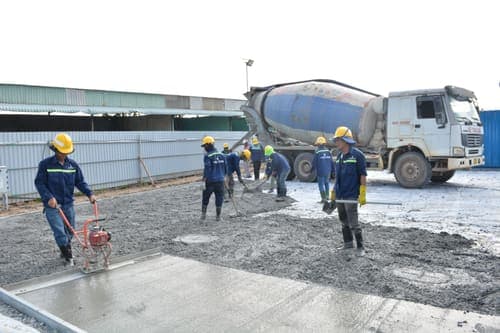
Concrete flatwork is everything you walk on, park on or set a grill on: patios, pads, garage floors, aprons. The job starts with a shovel, not a mixer. We strip sod and soft topsoil, dig down to firm ground, and compact a stone base in lifts so nothing settles under you later. Forms go in with the fall running away from the house. Pouring concrete slab work here means four inches over that base, six where a truck parks.
Then the finishing, which is where slabs get lost. Trowel it while bleed water is still sitting on the surface and you lock that moisture in, and the top flakes off by the next wet spring. We wait it out, then cut joints so the cracking goes where we decided. On stamped work, pattern, color and hand detailing move the stamped concrete cost more than size does.
What it costs
What it costs on a concrete flatwork job comes down to a few things I can size up in ten minutes standing in your yard. Square footage and thickness first, then whether the slab needs steel in it. Then access, which moves the number more than people expect: if the truck can back in and chute straight into the forms, that's easy money.
If we're wheeling mud around the side of the house past a fence and a gas meter, that's hours of labor, and labor is most of the bill. Tearing out a cracked old slab adds a day and a dumpster. Finish matters too, since a broom finish is quicker than a slate concrete stamp, which needs color, release and a wash down after.
Call me at (401) 394-6425 with the rough size and I'll talk you through it. Pouring concrete slab work in the cold stretch means blankets and mix changes, so timing counts as well.
When concrete flatwork is the wrong fix
There are jobs where concrete flatwork is the wrong answer, and pouring anyway just buries the problem under four fresh inches.
If your walk has dropped at one end but the slab is still in one piece, lifting it is the smarter move. Jacking concrete slab sections back to grade takes a fraction of the disruption, and pouring a new pad over a settling void gets you a crack in the same spot by next year.
If the trouble is the risers at your front door, that's concrete steps work, formed and poured as a unit, not a flat pad with a lip.
And if the surface is rotten clear through, no brick concrete stamp is saving it. That's concrete removal first, and hauling old concrete off a tight lot moves the number more than the pour does. Aprons and curbs are their own pour too, same as concrete paving out to the street.
Why choose us for this
You have concrete flatwork out front that has cracked, tipped or gone hollow underfoot, and what you actually want is to hire somebody once and not think about that surface again for twenty years.
So here is what moves my number: the square footage, how close the truck can park to the pour, how deep we dig out, and what the old ground has turned into. When a cheaper quote lands next to mine, look for what got left off, usually the base prep and hauling the broken slab away.
Pouring fresh concrete over soft fill is the one thing that does not happen on my jobs, because that is the part nobody sees and the only part that keeps the new work flat.
If jacking concrete slab back to level solves it, I will tell you that instead. The estimate is free either way.
Frequently asked questions
How long do I have to stay off a new pour?
Walk on it the next day, keep cars off for a full seven days. We pour flatwork at four inches over crushed stone, six where a truck or trailer sits. In July heat we keep the surface damp or covered so it doesn't flash-set and craze on top.
Can you pour over my old slab instead of ripping it out?
Only if what's underneath is stable. A concrete deck slab that's flaking on the surface but sitting flat takes an overlay fine. One with cracks that move, or edges settling toward the downspout, will telegraph straight through, and you've paid twice.
What moves the price on concrete flatwork?
Square footage, thickness, how much demolition and hauling there is, and whether the truck can get a chute to the pour or we're wheeling it through a gate.
Contact The Providence Concrete Company now
Contact our Providence concrete company now and tell me what you're standing on. Concrete flatwork is the flat stuff: slabs, aprons, patios, landings, garage floors. What I want to know on the call is how much square footage there is, how thick it needs to be for what's going to sit on it, and whether a truck can back up to the pour or we're wheeling it down a side alley in Fox Point.
Those are what move the price, far more than the finish does.
If what you're after is a waterproof deck over a garage or a finished room below, say so up front, because the drainage and the coating change how we build it.
Ring (401) 394-6425 between nine and five on weekdays and we'll book a look. If it genuinely can't wait, we'll find a weekend slot.