A flat gray slab out back that looks like a sidewalk somebody dropped in your yard.
Stamped concrete is the job where the mixer pulls away and the real work is just starting. We pour it in back yards and patios all over Providence and out toward the Cranston line, and what decides how it ages isn't the pattern you picked off a board. It's the color hardener for stamped concrete getting worked into the surface while the slab is still open, not dusted across the top like powdered sugar on a zeppole.
Skip that step and your textured concrete goes blotchy by the second summer. Square footage, the pattern you choose, and whether a wheelbarrow can actually reach the yard are what move the price.
There's plenty below on colors, patterns and how the pour goes. Call me at (401) 394-6425 and we will stand in the space together.
Textured Concrete
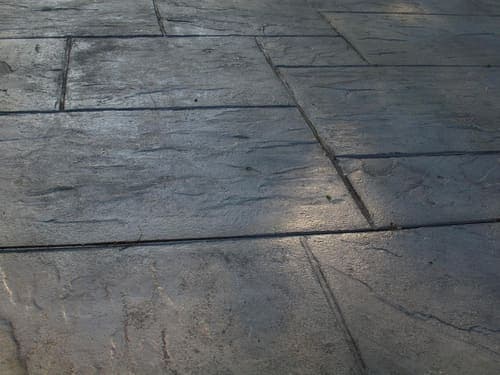
Textured concrete is stamping without the pattern lines, a seamless skin pressed into the wet slab so you get stone or weathered board grain with no repeating grid giving the game away. Plenty of the calls that come into Providence Concrete Company start with "I just want plain concrete with a bit of grip," and this is where they land.
We use it on steps, pool decks and around side doors, because texture with real depth still holds your boot when the January sleet blows in off the bay.
Timing is everything. Press the skins too late, after the slab has gone past its window, and you get a shallow ghost that wears off the high spots in a few winters.
Those same skins run vertically, so stamped walls and stamped concrete curbing can be matched to the slab beside them.
Exposed Aggregate Concrete
Exposed aggregate concrete is the one where the stone does the talking. We place the slab, spray a surface retarder across the fresh top, cover it, then come back the next morning and wash and brush the cement paste off until the pebbles stand proud. Timing is the whole job.
Go at it too early and the stones roll right out; leave it too long and you're fighting the surface with acid and a stiff broom, chasing an even look you'll never quite catch. Blotchy exposure doesn't buff out later.
It's grippy underfoot, which is why it suits pool aprons and shaded walks that stay damp, and it looks sharp running alongside a stamped concrete driveway or wrapped in a dark gray stamped concrete border. Stone choice, slab size and truck access all push the price around.
Stamped Concrete Driveway
A stamped concrete driveway takes a beating no patio ever will, so I build it heavier: five inches of concrete instead of four, a stone base rolled tight before a wheel touches it, and control joints cut within a day of the pour rather than whenever somebody remembers.
On driveways I work a color hardener for stamped concrete into the surface instead of leaning on integral color alone, because the hardener leaves a denser top that shrugs off tire scuff and the corner of a plow blade.
Where these go wrong is sealer. Too much of it, laid on too glossy, and you get hot tire pickup in August and something close to an ice rink in the first storm.
Size, slope, truck access and the state of whatever slab is there now all move the price. Then give it a week before you park on it.
Ashlar Slate Concrete Stamp
The ashlar slate concrete stamp is the one most folks point at without knowing its name: random rectangles in a repeating set of mats, with a slate grain pressed into the surface. We run those mats in rotation so the same rectangle never lands beside itself, and we snap our first line off the house so the joints stay square with your back door instead of drifting a finger's width every course.
Timing rules this one. Stamp too early and the mats sink and the joints mush shut. Too late and you get shallow lines that go pale in a couple of seasons. On a hot afternoon that window can shut inside an hour, so we bring enough hands to press the whole slab in one pass. Dark gray stamped concrete under a lighter release reads a lot like real blue stone stamped concrete.
Stamped Concrete Colors
Stamped concrete colors go into the slab, not on top of it. We either add integral color to the truck so the whole load is tinted through, or broadcast a color hardener across the fresh pour and float it in, which packs the surface tighter and holds tone better under Rhode Island winters. The release powder we cast before stamping settles into the grout lines and gives you that second, darker shade that makes the stone look like stone.
One thing people get wrong: wet concrete lies to you. It looks pale while curing, then deepens the day we seal it. Every job Providence Concrete Company pours gets a cured sample slab first, so you pick from the real thing rather than a chip card.
And keep it to one load per pour where we can. Two trucks, two batches, one visible seam.
Stamped Concrete Patterns And Colors
Stamped concrete patterns and colors get chosen together, in that order, because the same ashlar layout reads completely differently in a warm buff than it does in charcoal. I bring samples to your place and set them down outside, next to your siding and your existing walk, because kitchen lighting lies and so does a showroom. Scale matters as much as color.
A big random stone pattern on a four foot walkway looks like a giant stepped on it, and that's a mistake you live with for twenty years.
Every pattern in the Providence Concrete Company stack has been poured for somebody around here, so you're picking off real slabs, not a glossy card.
For patios, I usually push a base with a subtle secondary tone and keep stamped concrete edging in a contrasting border so the field has an edge to end at.
Stained Stamped Concrete
Stained stamped concrete is the move when one flat color reads too much like a sidewalk and you want that mottled, no two square feet alike look real bluestone has. We acid stain once the slab has cured, usually three to four weeks out, because reactive stain needs free lime to bite into. Stain a hard steel troweled surface and it sits on top, streaks, and lifts with the first sealer coat.
So we open the surface first, then two coats of sealer over it.
Most of the stained stamped work Providence Concrete Company takes on is patios and walkways, where you're standing three feet from it with a coffee and every blotch shows. Expect a re-coat every two to three years, sooner on anything you shovel and salt through a Providence winter.
Stamped Concrete Release Agent
That colored powder we throw ahead of the mats is the stamped concrete release agent, and it does two jobs at once: it keeps the rubber from sticking to green concrete, and it settles into the grout lines to give the slab depth. Skip it and the mats tear the texture. Wash it off too aggressively and you scrub away the shading that makes stamped concrete patterns and colors look like real stone instead of a placemat.
We let the slab cure a couple of days, then wash with a fan tip and a light detergent, holding back in the joints on purpose.
If you want a single flat tone with no antiquing, we use a liquid release instead. Ask us on the walkthrough. Nobody at Providence Concrete Company will talk you into contrast you did not want.
Gray Stamped Concrete
Gray stamped concrete is the one I'd put on my own house, and not because it's the safe answer. Plain gray sits right next to the granite curbing and slate you already see all over College Hill, so it isn't fighting your shutters or the stone on your front steps.
Plenty of folks ask for stamped concrete no color at all, just the natural mix with a charcoal release worked into the texture, which gives you a soft two-tone without anything that reads as painted on. Gray is honest, though. It shows every cold joint and every truck that turns up wetter than the last one, so we hold the same mix design across the whole pour and finish it in a single day.
Then it gets cured and sealed before the first hard freeze, because a raw slab drinks road salt all winter. That's how we run gray at Providence Concrete Company.
Stamped Concrete Edging
Stamped concrete edging is the band that runs around the outside of the slab, usually a brick or cobble border stamped by hand while the field is still setting, and it's where a job gets judged. Edges chip first. A plow blade in February, a lawn tractor tire, one freeze cycle under a slab poured thin at the perimeter, and you've got spalling right where everybody's eyes land.
So we thicken the edge, tool a slight radius on it so there's no sharp lip to break off, and hand press the border stamp instead of dragging a mat over it and hoping.
Contrast is the point too. A charcoal border around a warmer field, or a plain gray band framing a busier pattern.
Stamped concrete curbing around beds and islands is the same work, standing up.
Stamped Concrete Patio Colors
Stamped concrete patio colors get chosen off a little sample board indoors and then have to live outside in full sun, so I bring samples into the yard and hold them against your siding, your trim and your roof before anyone mixes a thing. Most folks here settle somewhere quiet: dark gray stamped concrete with a charcoal accent, or a blue stone stamped concrete that reads like soft slate once it cures out. We build the color two ways.
A color hardener for stamped concrete, broadcast into the wet surface and floated in, gives you a denser top and holds its tone. Integral color runs through the whole slab, so a chipped corner doesn't glow. What I'll talk you out of is painted stamped concrete, because paint lifts at the edges and then you're repainting forever. A one-accent gray stamped concrete patio takes less labor than a three-color layout, and that shows up in the quote.
Painted Stamped Concrete
Painted stamped concrete comes up most often when a slab has gone chalky and somebody wants it looking new again by Sunday night. Here's my worry: paint sits on top of the concrete instead of soaking into it. One Rhode Island winter of freeze, thaw and salt off your boots, and it starts peeling off the high points of the pattern first, which makes the slab look worse than the faded gray you started with.
If your patio came out flat and you're living with stamped concrete no color, let us look at whether a penetrating stain holds better on that surface. When Providence Concrete Company does paint one, we grind or etch it first, prime it, and roll a solid acrylic built for foot traffic, not porch paint off a shelf on Route 2. Two dry days, nothing under 50 degrees.
What the job involves
Stamped concrete is a real pour, not a coating troweled over something tired, so most of the work happens before anybody lays a mat down. We strip the sod, set the grade so water runs away from the house, put down crushed stone and tamp it, form the shape, then pour four inches, six where a truck or a trailer will sit.
Color goes in the mix or across the surface, and then we stamp while the slab is still open. That window is an hour or two, not an afternoon. Miss it and the pattern comes out faint and the grout lines never really read.
Stamped concrete edging, the border course, gets run by hand so the pattern doesn't drift crooked at a step or a curve. Size, truck access, and whether an old slab has to come out first are what move the price.
What it costs
Most of what it costs gets decided before we ever press a stamp into anything: what's under the slab, and what has to come out first. A clean rectangle out back where the truck can reach the forms is the easy version. A tight side yard where every load rides a wheelbarrow through a gate is not. Breaking up a cracked old pad adds a day and a dumpster. Slab thickness, wire or rebar, and the finish all count too.
Integral color with one release is simpler work than color hardener for stamped concrete broadcast and troweled by hand, which is what gives blue stone stamped concrete that layered, quarried look. A late-fall pour means blankets and patience.
Give us a call at (401) 394-6425 with rough dimensions and we'll size up the access. A gray stamped concrete patio in an open yard and the same patio behind a fence price out nothing alike.
When stamped concrete is the wrong fix
Stamped concrete is the wrong fix on a slab that's already moving. Stamp over a concrete patio that has settled at one corner or cracked clean through, and all you've bought is a handsome pattern with a fault line running across it. That one starts with concrete repair, or a tear out and a fresh pour, and yes, breaking up and hauling the old slab adds real money to the job.
Same story if water is running back toward the house. Sort the grade and whatever's going on at the concrete foundation before anybody makes it pretty.
And if you plow your own concrete driveway with a steel blade, deep texture gets scalped at the high spots. A broom finish or exposed aggregate concrete takes that abuse better than most decorative concrete finishes will.
Why choose us for this
You want the stamped concrete out back handled once, by somebody who finishes it, so what you end up with is a patio and not a project you have to keep an eye on. That's the whole ask, and it's fair.
Here's where a cheaper number usually comes from. One coat of sealer instead of two. Release agent that never gets washed properly out of the grout lines, so your gray stamped concrete patio goes blotchy by the second summer. Joints cut late, so a crack wanders straight across an ashlar slate concrete stamp you picked out from a dozen samples.
What actually moves your number is the size, how close a truck can get to the back yard, whether an old slab has to come out first, and the stamped concrete patterns and colors you settle on. An estimate ties you to nothing. Sit with it a week if you like.
Frequently asked questions
Can I get stamped concrete over the patio I already have?
Sometimes. If the slab is sound, drains away from the house, and isn't spalling at the surface, we can resurface and stamp on top of it. If it's heaved or crumbling at the edges, topping it only buys a season or two. That one comes out and we pour new at four inches over crushed stone, with stamped concrete curbing along the beds if you want the edge finished at the same time.
How long am I off it?
Foot traffic in two to three days, once we've washed off the release agent and the sealer has gone down. Keep vehicles and heavy furniture off for a week.
Will it crack?
Concrete cracks, so the work is deciding where. We cut control joints and hide them in the pattern lines, and we don't pour color work on nights heading toward freezing, because the slab sets unevenly and the finish shows it.
Contact The Providence Concrete Company now
Looking for a Providence concrete company to put stamped concrete in the back yard instead of another flat gray pad? The number is (401) 394-6425. Before anything else, I want to stand on the spot with you and look at three things: where the water runs off the roof, how wide the gate or the side path is, and whether a truck can chute straight in or we are renting a pump to reach over the garage.
Access changes the day more than the pattern ever does.
Save a photo of something you liked, even a bad one off your phone. We can talk through pattern, edge detail, and whether color hardener for stamped concrete gets you the tone you want or integral color is the smarter move. Messages left in the evening get returned the next working day.